

Platform Development — Case Study
Building Intelligence Into Property Management
A global property management solutions provider collaborated with our team to build an AI-powered intelligence layer that turns static operational data into actionable insights.
Client Background
Our client is a global provider of integrated property management software serving boutique hotels, luxury lodges, and adventure hospitality operations across 35 countries. Decision-makers faced a critical constraint: manual reporting cycles stretched beyond three weeks, rendering competitive intelligence obsolete before it reached executive teams.
The Challenge
Operations teams spent upwards of 20 days each cycle aggregating performance data across properties, stitching together fragmented reports that arrived too late to influence pricing, staffing, or competitive positioning. Decision-makers operated in a reactive posture, analyzing last month's occupancy trends while competitors adjusted rates in real-time based on market signals.
Solution Overview
An AI copilot architecture embedded directly into the existing PMS interface.
Conversational Intelligence
Natural language queries across all operational screens
The copilot embeds directly into the existing PMS interface as a conversational assistant, accessible from front-desk check-ins to executive dashboards. Users ask business questions in natural language while the system autonomously retrieves relevant data and returns contextualized insights.
Query Templates
Pre-configured queries for recurring analytical workflows — monthly performance reviews, competitive positioning assessments, occupancy forecasting. Teams receive interpreted insights within seconds.
Agentic Search
For complex exploratory questions, the system autonomously identifies relevant data across sources and constructs analytical pathways that surface root causes with transparent reasoning.
System Architecture
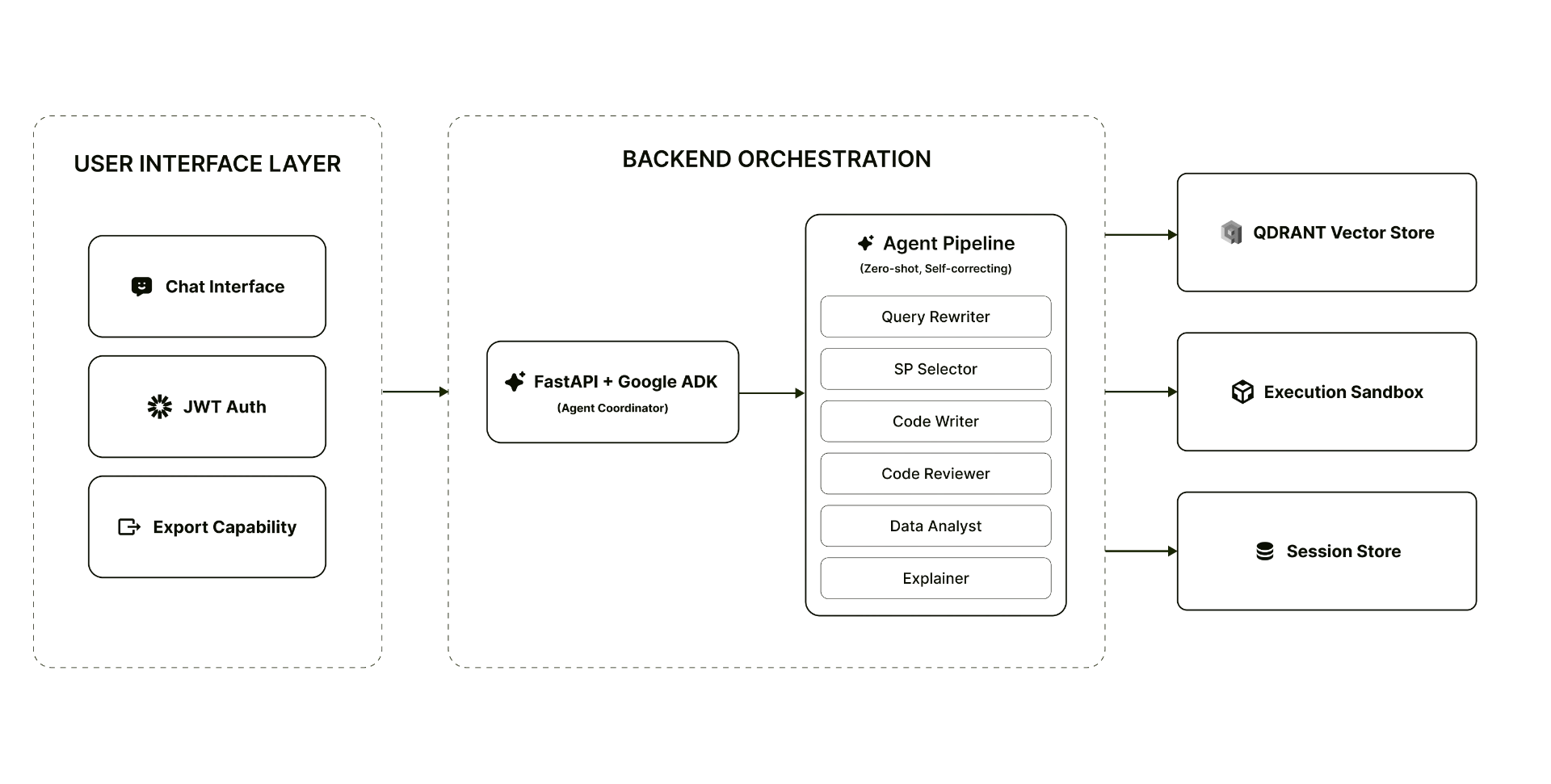
User Interface Layer · Backend Orchestration · Agent Pipeline · Vector Store
Technical Architecture
The AI pipeline uses zero-shot agent orchestration with a dual-LLM stack: GPT-5 Mini for code synthesis and Gemini 2.5 Flash for contextual reasoning, with self-correction through bounded iteration loops and automated validation.
The retrieval system leverages a Qdrant vector database with OpenAI text-embedding-3-large embeddings, performing semantic matching across 15+ stored procedures to identify 3–5 relevant candidates per query — achieving 60–70% token reduction versus full schema preloading.
Infrastructure runs on FastAPI with Google ADK and an asyncio execution sandbox on the backend, React/Vite with WebSocket streaming on the frontend, containerized via Docker with automated RAG ingestion on startup.
Operational Impact
Immediate, measurable outcomes from deployment.
20+ days
< 24 hrs
Reporting cycle time
Manual SQL/Excel
Natural language
Query interface
Full schema load
60–70% fewer tokens
Via semantic retrieval
Reactive insights
Real-time
Decision intelligence
Strategic Outcomes
The AI copilot reduced reporting cycles to under 24 hours, enabling managers to adjust strategies while market opportunities remain actionable. Operational teams redirected substantial manual data compilation hours toward strategic analysis and guest engagement.
The solution fundamentally reshaped how property managers allocate their highest-value resource: time — transforming reactive data consumption into proactive, real-time intelligence across 35 countries.

Ready to build your revenue architecture?
AI-powered systems like these are part of the infrastructure we design for growth-focused companies.
Schedule a Strategy CallExplore Other Case Studies
Agentic Systems
Chemical Regulations Breaks Barriers With AI Agents
AI agents reduced RFP processing from 32 hours to 15 minutes — a 95% decrease in operational resources.
Read case studyAgentic Solution
From 30-Minute Waits to Instant Translation in Emergency Care
An offline-first AI translation system eliminated interpreter waits and reduced per-encounter costs to zero.
Read case study