

Agentic Systems — Case Study
Chemical Regulations Breaks Barriers With AI Agents
A major chemical regulations firm serving brands across America and Europe collaborated with our team to tackle critical barriers in their sales and operations workflows using AI agents.
Our Client
Our client operates at the intersection of environmental health and safety (EHS), providing regulatory compliance services across 11 languages to major brands spanning Asia-Pacific, European, and Latin American markets.
Core Challenges
The client's growth trajectory faced two key operational constraints.
Language Barriers
Their sales department provides services in 11 languages but encountered systematic communication breakdowns during client interactions. Language barriers became particularly acute across international operations where regulatory frameworks vary and real-time technical consultation requires nuanced understanding of local compliance requirements.
Inefficient Complex Workflows
Their Solutions Engineering team experienced severe inefficiencies in RFP completion workflows. Each proposal — typically containing 50–100 technical questions — required up to 32 hours of manual, cross-departmental labor, limiting their ability to pursue concurrent opportunities.
Solution Overview
A dual-component solution leveraging fine-tuned OSS models with complete data privacy controls.
Realtime Translation Platform (RTT)
Multi-lingual · On-device · Sub-3-second latency
Delivers on-device multi-lingual translation through a sequential processing pipeline with sub-3-second response latency. The system combines OpenAI's Whisper-v3 for speech-to-text and Qwen2.5-7b-Instruct for bidirectional translations and contextual suggestions, paired with MeloTTS for final audio synthesis.
RFP Automation System
Intelligent document processing · Collaborative answer generation
Automates proposal workflows through intelligent document processing and collaborative answer generation. The platform uses Qwen2.5-7b models for query extraction paired with FAISS vector search grounded in a 6,000-node knowledge graph. Features a prompt-first architecture with Chain-of-Thought and Monte-Carlo Simulation techniques.
System Architecture
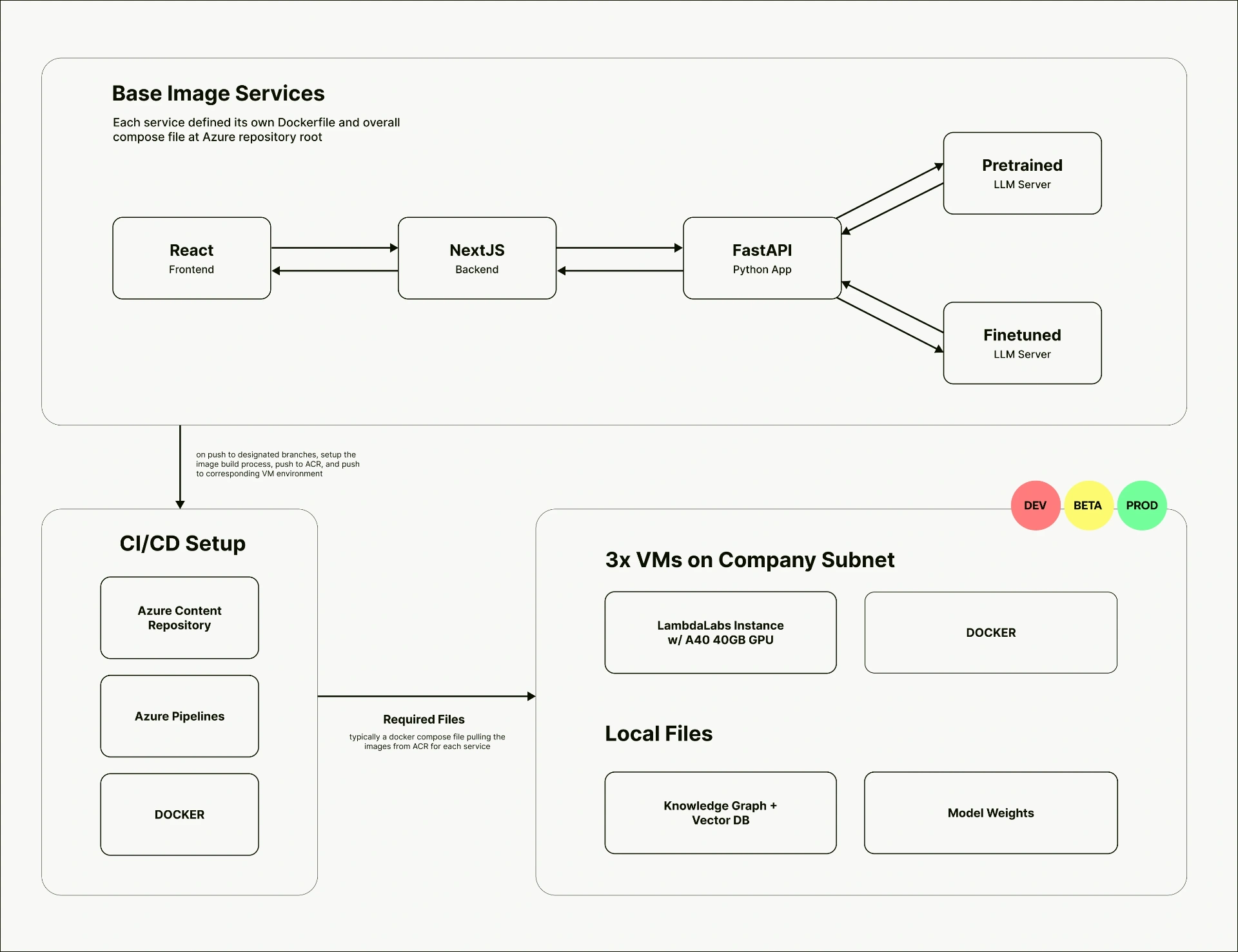
Deployment architecture across LambdaLabs A40 instances with Azure CI/CD pipelines
Technical Implementation
The RFP platform deployed across three LambdaLabs A40 instances (DEV/BETA/PROD), with Azure CI/CD pipelines managing version control and deployment automation. The architecture separated frontend UI, request management, and Python LLM API layers.
The RTT system evolved into a streamlined translation API utilizing LiteLLM routing to SambaNova's Qwen3-32B model, delivering accelerated generation speeds through pre-defined translation prompts.
FAISS implementation achieved sub-600-millisecond query response times while maintaining regulatory compliance through knowledge graph retention.
Operational Impact
Immediate, measurable outcomes from deployment.
32 hours
10–15 min
Per proposal completion
4-day turnaround
Same day
Proposal delivery
Manual queries
Sub-600ms
Query response time
Cross-dept bottleneck
29–30 hrs saved
Per proposal
Strategic Outcomes
Our client expanded their automation capabilities to encompass new document classes and client-facing communication systems. The Solutions Engineering team saves 29–30 hours per proposal while maintaining specialized technical quality standards.
The foundations established position the client to scale their global compliance services without bottlenecks in operations — transforming what was once a manual constraint into a competitive advantage.

Ready to build your revenue architecture?
AI-powered systems like these are part of the infrastructure we design for growth-focused companies.
Schedule a Strategy CallExplore Other Case Studies
Agentic Solution
From 30-Minute Waits to Instant Translation in Emergency Care
An offline-first AI translation system eliminated interpreter waits and reduced per-encounter costs to zero.
Read case studyPlatform Development
Building Intelligence Into Property Management
An AI copilot reduced 20-day reporting cycles to under 24 hours for a global hospitality provider.
Read case study