
Agentic Solution — Case Study
From 30-Minute Waits to Instant Translation
A healthcare facility serving diverse patient populations collaborated with our team to eliminate recurring interpreter expenses and 15–30 minute wait times by deploying an offline-first medical translation system.
Client Background
A medical facility serving diverse patient populations confronted the limitations of traditional interpreter services: scheduled availability creating emergency workflow disruptions, minimum billing windows regardless of actual usage, and per-session costs compounding across thousands of annual encounters. The constraint extended beyond economics — third-party coordination introduced privacy vulnerabilities and delayed time-sensitive decisions in acute care settings.
Problem Statement
Language service dependencies created three compounding friction points in clinical operations.
Cost Accumulation
Per-encounter interpreter costs ranging from $45–150/hr for in-person services and $1.25–3.00/min for telephonic interpretation, accumulating across patient volume.
Wait-Time Inefficiencies
Averaging 15–30 minutes per request in emergency departments, directly impacting bed turnover rates and triage throughput.
Privacy Complications
External service provider integration required ongoing compliance oversight and expanded the attack surface for protected health information handling.
Our Solution
An on-premises medical translation platform eliminating external interpreter dependencies entirely.
Offline-First AI Translation
100+ languages · Sub-2 second response · Zero data transmission
AI inference models run locally on facility hardware, processing 100+ languages with sub-2 second response time while maintaining zero data transmission outside facility bounds.
Tiered Clinical Response
Urgency-matched processing across care scenarios
Quick Mode (1–2s): Emergency triage and rapid assessment protocols
Professional Mode (2–4s): Standard consultation workflows
Expert Mode (3–6s): Complex procedure explanations, surgical consent, oncology consultations
Clinical Integration Points
Emergency Triage
First-contact patient assessment replacing phone interpreter queuing at triage stations.
Bedside Tablets
Real-time consultation translation during physician rounds and nursing care.
Outpatient Rooms
Consultation workflow integration via existing tablet infrastructure in examination rooms.
System Architecture
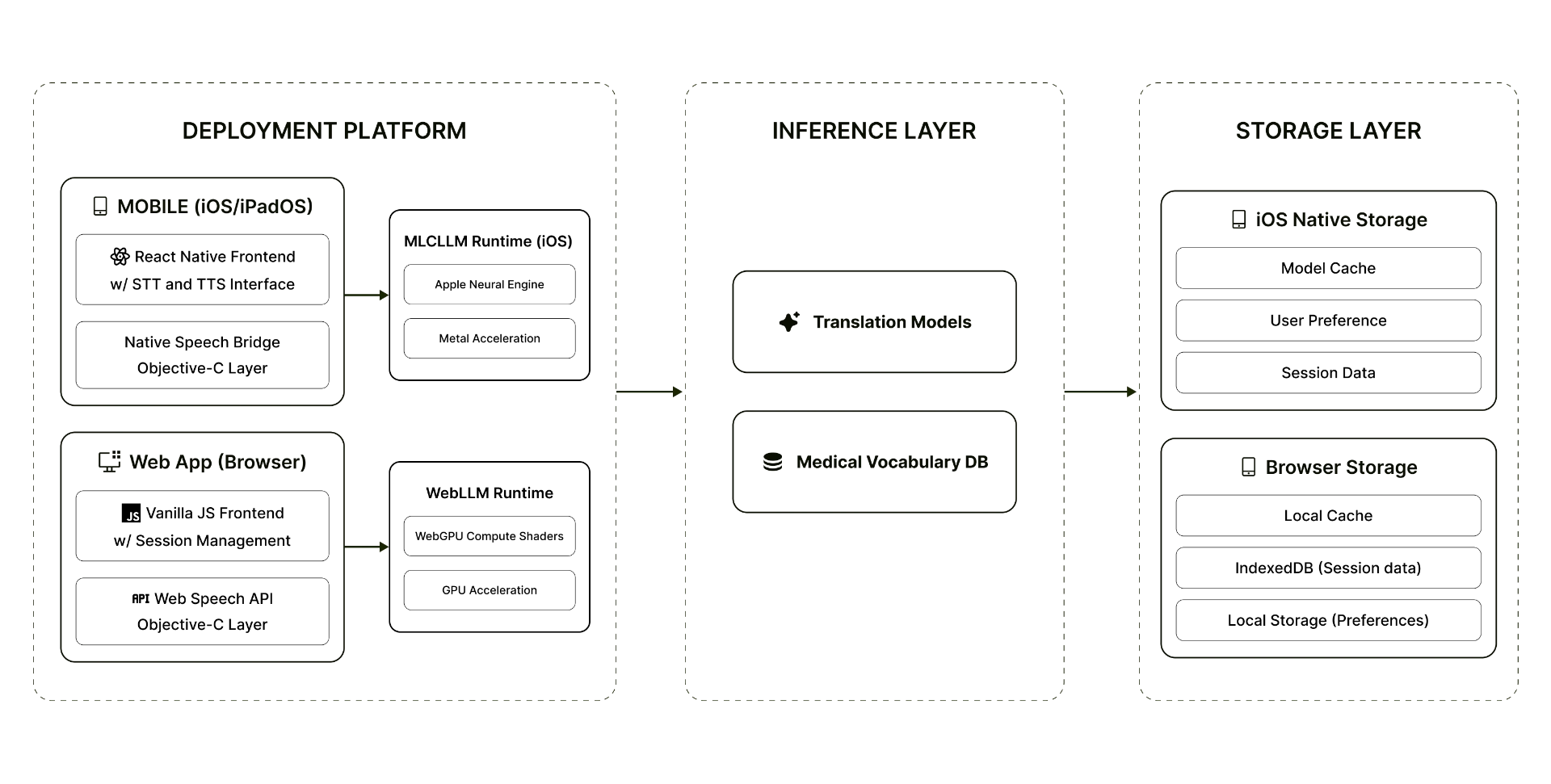
Three-tier architecture: Deployment Platform · Inference Layer · Storage Layer
Technical Architecture
The system uses MLCLLM SDK with Apple Neural Engine acceleration on iOS/iPadOS Silicon devices, and WebGPU compute shaders for zero-server-dependency in-browser inference on web platforms.
Model distribution uses IPFS-hosted binaries with content-addressed verification — a single download establishes permanent offline capability. Complete operational continuity is maintained during internet outages, bandwidth saturation, or facility network maintenance.
Medical vocabulary coverage encompasses anatomical nomenclature, symptom descriptors, pharmaceutical classifications, and procedure-specific lexicons across 100+ languages.
Operational Impact
Immediate, measurable outcomes from deployment.
15–30 min wait
< 2 sec
Emergency triage response
$45–150/hr
$0 marginal
Per-encounter cost
Limited languages
100+
Languages supported
Internet dependent
Fully offline
Network independence
Strategic Outcomes
The facility transformed language access from a cost center dependent on external coordination into an instantaneous, zero-marginal-cost operational capability — achieving instant language coverage across 100+ languages with 24/7 availability.
Privacy architecture simplifies compliance posture through complete on-premises processing, removing third-party data handling from the risk equation. The facility now extends translation capabilities into telehealth delivery channels and multi-site deployment — scaling language access without scaling costs.
Ready to build your revenue architecture?
AI-powered systems like these are part of the infrastructure we design for growth-focused companies.
Schedule a Strategy CallExplore Other Case Studies
Agentic Systems
Chemical Regulations Breaks Barriers With AI Agents
AI agents reduced RFP processing from 32 hours to 15 minutes — a 95% decrease in operational resources.
Read case studyPlatform Development
Building Intelligence Into Property Management
An AI copilot reduced 20-day reporting cycles to under 24 hours for a global hospitality provider.
Read case study