

For weeks, the internet reaction to "ChatGPT ads" has been predictable:
"Here we go. Another platform ruined by ads."
But that framing misses the real story.
OpenAI isn't just adding another ad placement.
They're attempting something much harder — and much more consequential for businesses.
They're trying to monetize without corrupting the answer.
If they fail, ChatGPT loses trust and relevance overnight.
If they succeed, this becomes one of the most important shifts in digital marketing since paid search.
Below is what business owners, ecommerce brands, and service providers actually need to understand — minus the hype.
What OpenAI Is Actually Rolling Out (So Far)
OpenAI has confirmed it will begin testing ads inside ChatGPT with a limited rollout:
- Ads will appear only for logged-in adult users on Free and Go plans (not Plus, Pro, Business, or Enterprise)
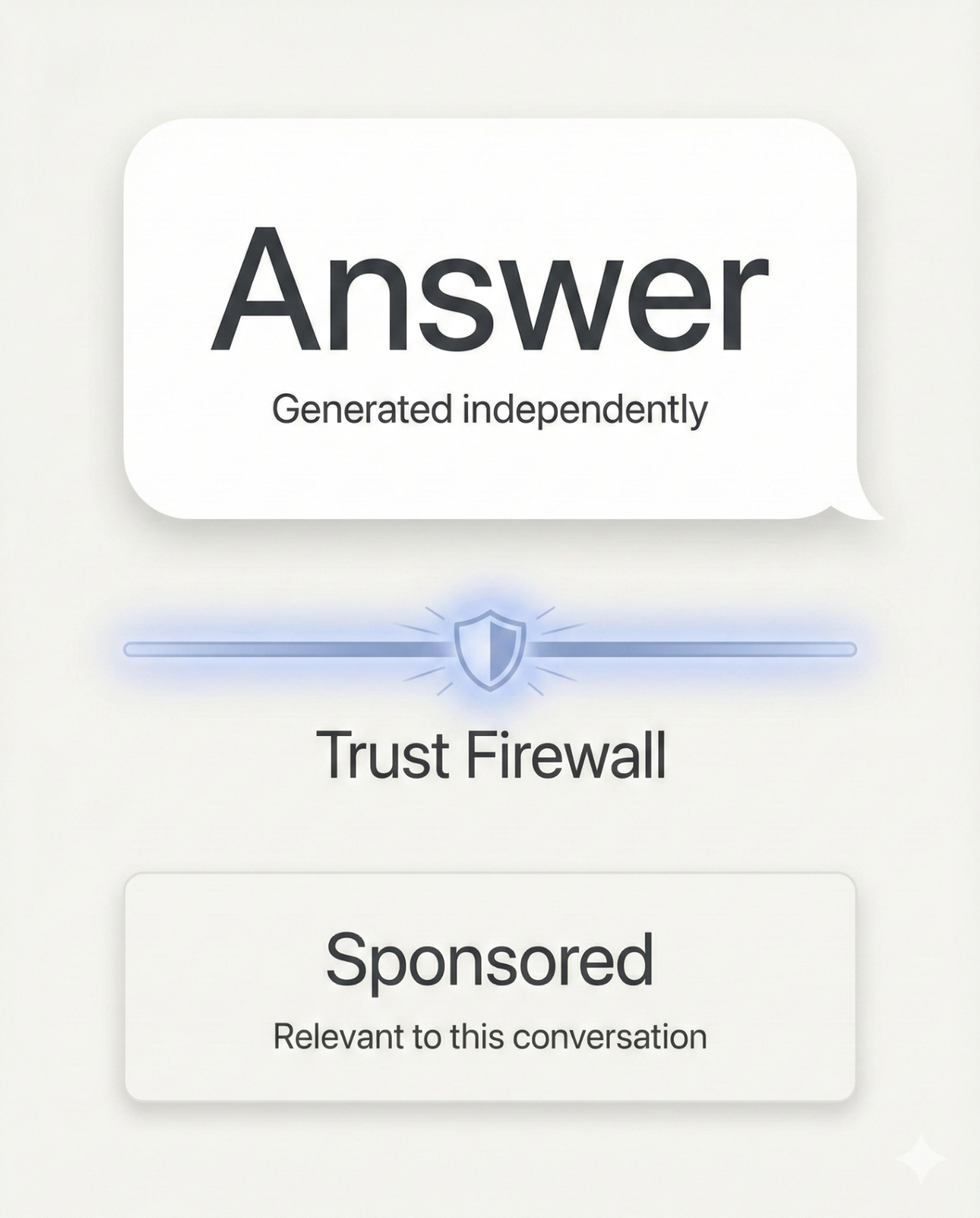
- Ads will be clearly labeled and shown below the AI's answer, not embedded inside it
- Ads will appear only when relevant to the current conversation
OpenAI is explicitly committing to:
- Answer independence (ads do not influence responses)
- Conversation privacy (no selling chats to advertisers)
- User control over ad personalization
This last point is critical — and rare.
The Key Distinction
OpenAI isn't positioning ads as the product.
They're positioning trust as the product.
That distinction changes everything.
Why ChatGPT Ads Are Fundamentally Different
To understand the opportunity, you first have to understand how this differs from every major ad platform today.
Google monetizes keywords.
Meta monetizes attention.
ChatGPT monetizes intent in motion.
This is not discovery-stage browsing.
This is decision-stage thinking.
When someone talks to ChatGPT, they don't just say what they want. They explain:
- budget constraints
- timelines
- preferences
- deal-breakers
- alternatives they're actively considering
That means targeting no longer relies on cookies, pixels, or inferred interest graphs.
The conversation itself becomes the intent signal.
For advertisers, this is a completely different game.
The "Trust Firewall" That Reshapes Competition
OpenAI has drawn a hard line:
Ads cannot change the answer.
This single constraint reshapes how brands compete.
On Meta or Google, the highest bidder can often overpower the best option.
On ChatGPT, that approach collapses.
If your product or service isn't genuinely competitive, no amount of spend should be able to override reality — because the AI's recommendation must remain intact.
What this means for business owners
- You can't win by simply outspending better solutions
- You can't rely on vague positioning or inflated claims
- Your offer has to hold up under direct comparison
This environment favors:
- clearly differentiated products
- niche service providers
- brands that know exactly who they're for — and who they're not
In short: alignment beats budget.
From Ads to Conversations (The Real Opportunity)
OpenAI has already hinted that ads won't remain static.
The direction is clear:
Interactive, conversational ads.
Instead of:
"Click here → land → scroll → decide"
The new flow becomes:
"Ask → clarify → compare → decide"
All inside the ad experience itself.
What this unlocks for ecommerce brands
- Fewer clicks, but significantly higher intent
- Greater emphasis on education, use cases, and product fit
- Less reliance on hype, more reliance on clarity
What this unlocks for service businesses
- Pre-qualified leads before the calendar link
- Objections handled inside the conversation
- Fewer wasted calls and better-fit clients
At that point, the ad stops being an interruption.
It becomes a decision assistant.
How Smart Businesses Should Prepare Now
You don't need access to ChatGPT ads to start preparing.
Begin here:
1. List the top five questions customers ask before buying
If ChatGPT asked those questions today, could you answer them better than your competitors?
2. Clarify who you're not for
Conversational ads reward honesty, specificity, and boundaries.
3. Stress-test your offer
Ask yourself: If a customer asked ChatGPT whether this is right for them… would the honest answer recommend us?
That's the new bar.
The Bigger Shift
This isn't Meta 2.0.
This isn't Google 3.0.
It's something else entirely.
A system designed to sit inside the decision, not before it and not after it.
And for the first time in a long time, platforms may finally be incentivized to reward the best answer, not the biggest budget.
If OpenAI gets this right, the advantage won't go to the loudest advertisers.
It will go to the most useful ones.
Want help preparing your business for the shift to conversational commerce?
Talk To Jen